


FLASH NEWS
Berisha: 490 thousand pensioners receive partial pension, living more difficult than under socialism

2026-05-07 19:51:42 / POLITIKË
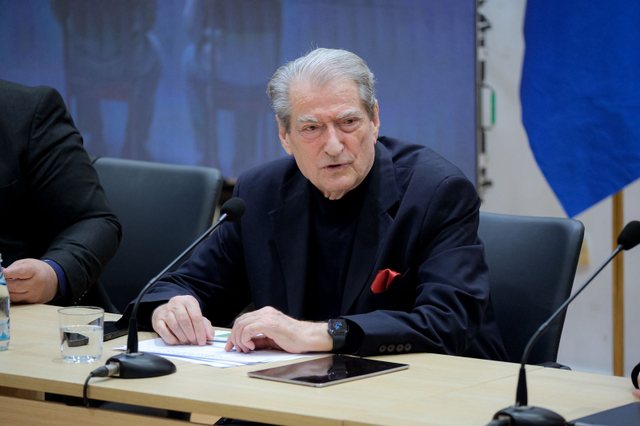
The leader of the Democratic Party, Sali Berisha, has stated that pensioners in Albania are living in difficult economic conditions, while accusing the government of deepening poverty and the lack of supportive policies for the elderly.
At the roundtable of the Department of Economy and Finance: "Pensioners, the oppressed", Berisha said that over a third of the country's population lives in poverty, emphasizing that around 490 thousand pensioners receive partial pensions.
"They do not receive the full minimum pension, but a partial pension, i.e. crumbs. With today's prices, they lead a very difficult life, in some aspects more difficult than under socialism," he said.
According to Berisha, the increase in pensions has not followed the increase in prices, especially of basic products and food, which, according to him, constitute the main expenses of pensioners.
He stated that real inflation for the basic food basket is much higher than the official inflation reported by the government.
"It is said that inflation is 2%, but food inflation can be 15%. The pensioner spends all his income on food and medicine," said Berisha.
Berisha: 490 thousand pensioners receive partial pension, live a life in some aspects more difficult than under socialism. Good evening and a heartfelt greeting to all of you present here, but also to all Albanian pensioners. A greeting to Dori and Hysen and thanks for the work.
Today we are dealing with one of the most painful, most worrying problems for Albanian society. We are dealing with the problem of pensions for over 1/3 of the country's population, which lives in poverty, even if it is for the pension they receive, in extreme poverty. Perhaps we should take into account one thing, that about 490,000 pensioners receive partial pensions. They do not receive the full minimum pension, but they receive a partial pension. Which means, crumbs. And if we take into account market prices, they have a very, very difficult life.
They have a life, in some aspects, more difficult than in socialism. Where, with what they received, they bought what they had. At those symbolic prices. Whereas today the prices are no longer symbolic. The prices are completely determined by the market. And in Albania, the phenomenon, the most negative development has been this, that the increase in salaries and pensions has not followed the increase in prices. And, in Albania, inflation, as a whole, compared to selective inflation, inflation, let's call it the basket of the most necessary goods, food and goods most necessary for the pensioner. This second inflation, in reality, can be 10, 20 times greater, higher than inflation as a whole.
So, if you take it, we are dealing with, in, if we use them, we are dealing with an unprecedented cynicism of figures. Let's say that inflation was 2%, food inflation that month could have been 15%. But with this little money that he has, he has it all concentrated in that basket. He can't even get food. So, it's an extremely serious situation. It's an absolutely unacceptable situation. There is no more unequal distribution of income than this.
It has a more cynical attitude. And it is all handmade, made by the government. Because, in 2013, pensions were what they were, they were the highest in the region. Higher than in Serbia, higher than what it has today, Serbia today has an average pension of 488 euros. They were higher than in Macedonia, higher than in, higher than in Romania, higher than in Bulgaria. They were two member states of the European Union. Of course, continuing this trend should be an absolute major obligation of the government.
What did the government do? It doubled taxes. The government claimed that it was indexing pensions. What indexation? Indexation with the general inflation indicator. Pensioners got two eggs in their hands. But indexation with, with selective inflation has never been considered for them. So they remain, remain, in a stagnant place, or with very modest growth, at a time when prices increased by over 100%. At a time when the goods of what is called the basket became more expensive, not than in Serbia, not than in Macedonia, or Montenegro, but they became more expensive than in Italy, than in Greece, than in Germany in some cases. Plus, the health care bill for these men and women. So, irresponsibly, in the most irresponsible way, pensioners sank deeper and deeper into misery.
Happening now...







Sali Llapa
Nga Bato Kosova
ideas


top



Alfa recipes






services
- POLICE129
- STREET POLICE126
- AMBULANCE112
- FIREFIGHTER128