


FLASH NEWS
Opposition without trust/ Why Berisha's "Rama is gone!" model is not producing change

2026-04-06 11:21:54 / POLITIKË
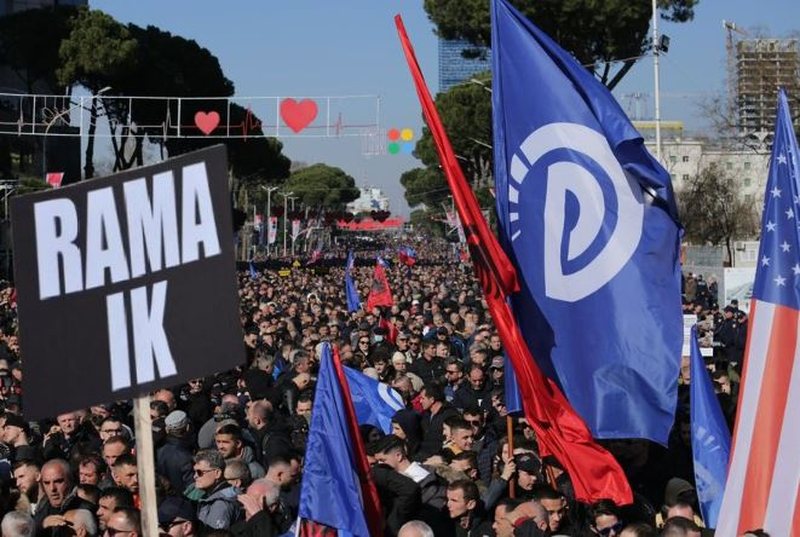
In any democratic system, the opposition is the engine of change. It is not measured only by the denunciations it makes, but above all by the trust it manages to instill in citizens.
In our country, the opposition and Berisha seem to be facing precisely this crisis, the lack of public trust.
The rhetoric is strong, the accusations are daily, while the denunciations of corruption are numerous. The opposition itself speaks of an alarming level of corruption in the government of Edi Rama. But the question that naturally arises is, if corruption is so great and so visible, why don't citizens react massively?
The answer seems simple and at the same time painful for the opposition, because they don't believe it.
The opposition has failed to produce real civic mobilization. Sporadic rallies with a few hundred protesters are not enough to create political pressure. History has shown that big changes do not come from “200 people every Monday,” but from massive and sustained participation.
In other countries, citizens have forced resignations through public pressure. In Albania, even when there have been important developments, the decisive role has often not been that of the opposition, but of institutions like SPAK. This weakens the narrative of the opposition as a force for change.
The opposition's political discourse has remained stuck in a repetitive cycle: "Rama go!"
This message, worn out for years, no longer produces any effect. On the contrary, it has become a cliché that mobilizes no one.
At the same time, frequent media appearances and "speeches" have not been translated into concrete strategies. There is a huge gap between words and action. The government is not overthrown by television statements, but by credible alternatives and serious political organization.
One of the biggest problems of the opposition is the public perception that it represents the same individuals, the same political cycle, and the same governing culture. There is no real space for the new generation, for new ideas, and for a new leadership model.
This creates a vacuum: citizens dissatisfied with the government do not see the opposition as an alternative. They do not protest not because they are satisfied, but because they do not see a “green light” for change.
Another element that undermines trust is the perception that a part of the political elite, both in power and in the opposition, have intertwined economic interests. When citizens believe that politics and business are closely linked, then any call for protest loses credibility.
In this context, accusations of corruption against various political figures, whether in government or opposition, no longer produce new indignation, but a kind of collective apathy.
Sali Berisha himself has shown in the past that he knows how to build alliances and create a winning spirit. The victory of 2005 came as a result of the union of various factors and the division of the opponent.
Today, the situation is the opposite. The opposition is fragmented, while efforts for unity seem more symbolic than real. Calls for cooperation have not been accompanied by concrete mechanisms and mutual trust.
The main problem is not the lack of scandals to denounce, but the lack of a convincing alternative. Albanian citizens are no longer willing to replace a model they consider corrupt with another that is perceived as such.
Without deep reform, without openness to new figures, and without a clear political project, the opposition risks remaining in a peripheral role: political noise without real impact.
In the end, one fundamental question remains: does the opposition really seek power to change the system, or simply to replace it? Until this dilemma is clearly answered in the eyes of citizens, distrust will continue to be the greatest obstacle to any political rotation in Albania./ BW
Happening now...







ideas

When cardboard and arrogance become law.
Nga Gjergji Nika

Renaissance is Disaster Capitalism
Nga Klodian Tomorri
Pse tifozeria e Kosovës ishte aq e vdekur dhe mungonin simbolet kuqezi?
Nga Kreshnik Spahiu
top



Alfa recipes

TRENDING 




services
- POLICE129
- STREET POLICE126
- AMBULANCE112
- FIREFIGHTER128