


FLASH NEWS
We don't need leaders, nor heroes.

2026-04-10 22:11:21 / IDE
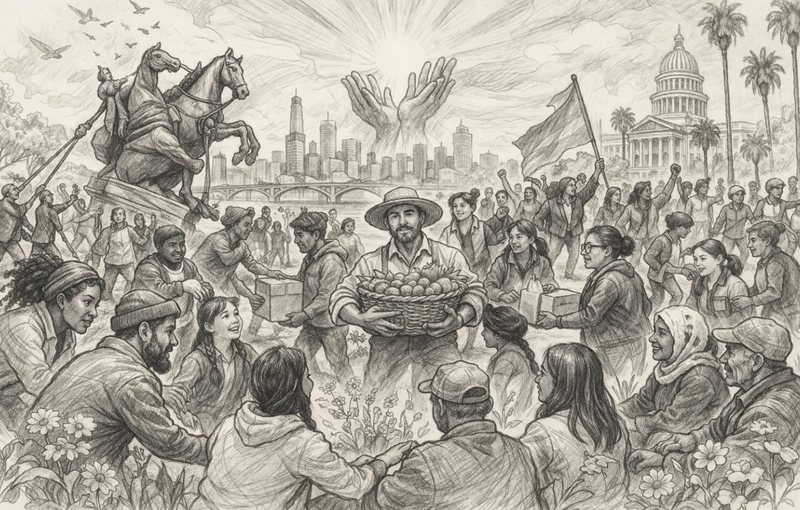
Often, too often, we commemorate history by glorifying a single individual, with a statue, or by naming a place or holiday after them. Some statues have been torn down, and in some cities across the United States, those of General Robert E. Lee have been replaced with statues dedicated to the anti-slavery activist Harriet Tubman, but Republicans are trying to reverse this trend. Most recently, the Trump administration placed a statue of Christopher Columbus on the White House grounds, a replica of the one that was tossed into Baltimore Harbor in 2020 during Black Lives Matter protests against racism and colonialism.
Maybe the age of heroes is coming to an end.
This year, Jon Wiener, the editor of The Nation magazine, has nominated the city of Minneapolis for the Nobel Peace Prize, for the courage and solidarity of its citizens in opposing ICE. Winning the Nobel is a remote possibility, but residents of Minneapolis and St. Paul have already received the Profile in Courage award, named after John F. Kennedy, “for risking their lives in defense of their neighbors and immigrant communities.”
On March 31, California celebrated its first Farmworkers Day, a holiday hastily declared by the state legislature after revelations of sexual abuse by César Chávez, the famous farmworker union leader. Perhaps we are realizing that often the hero is the collective, the movement, the community, and that singling out an individual to sanctify them doesn’t work. Many people who have become heroes in their lifetimes have done things for which they didn’t deserve the recognition.
But even when their lives are impeccable, the world doesn't change just because of individuals. Sometimes one person, a writer, a preacher, a visionary, inspires the masses. Sometimes he works with a group. These people are often called leaders, but I consider them catalysts.
To call someone a leader is to implicitly consider everyone else as a follower. Followers obey, like a herd, while in many revolts and movements, everyone has chosen to be there.
The word “leader” probably comes from a time when military commanders led troops into battle. However, almost all of the changes of recent decades have not been achieved with weapons. The engine of most democratic movements is made up of people participating in decision-making. At this moment, we are trying to defend democracy, and democracy within movements is essential.
“Aquí manda el pueblo y el gobierno obedece,” here the people command and the government obeys, was a slogan of the Zapatistas, indigenous revolutionaries who rose up in southern Mexico in 1994. A catalyst is someone who knows how to motivate people and hold a group together. But there is no catalyst if there is no population to catalyze, to direct them towards a community or a movement. The Nobel Prize in recent decades has often been awarded to collective organizations, such as the Center for Civil Liberties (founded in Kiev), the World Food Program, and the Intergovernmental Panel on Climate Change (during the time of Al Gore).
I've always thought that Hollywood action movie heroes give people the wrong idea about how change is achieved. They're often muscular or heavily armed men whose only talent is hand-to-hand violence.
It's clear that people in the Trump administration have seen a lot of these films: Defense Secretary Pete Hegseth and FBI Director Kash Patel seem to believe that their subordinates should focus on hand-to-hand combat.
Patel has even invited several UFC fighters, the American mixed martial arts organization, to "train" FBI agents.
Minneapolis' heroes have not resorted to violence: they faced armed invaders in bitter cold conditions, day after day, and continue to deliver food to people who cannot leave their homes, accompanying their children to school.
They have had a huge impact on protecting their neighborhoods. And, like people in Los Angeles, Charlotte, Chicago, and Memphis, they have become an inspiration to everyone else.
Although Farmworker Day was born out of an unfortunate circumstance, it is a useful thing in California, where most farmworkers are immigrants, like the people persecuted by ICE. It would be fitting to erect a monument to the unknown farmworker, or rather to the millions of workers who have been over the years. Dedicating a day to them would be a start. / Rebecca Solnit is an American writer /The Guardian – bota.al
Happening now...


Denouncing Berishism is a prerequisite for denouncing the government
Nga Blendi Kajsiu
ideas

top


Alfa recipes


TRENDING 




services
- POLICE129
- STREET POLICE126
- AMBULANCE112
- FIREFIGHTER128