


FLASH NEWS
Why the protests are raging: Rama in prison, Berisha in prison!

2026-06-03 18:28:34 / IDE
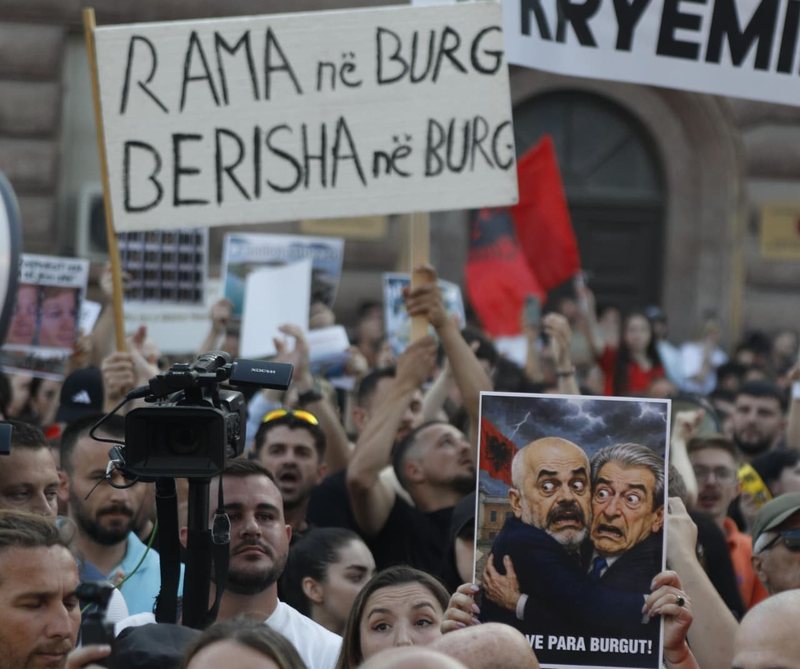
In recent days, in civil society protests, protesters have been simultaneously chanting: "Rama in prison! Berisha in prison!".
A slogan, which at first glance seems like a simple cry of anger, semantically seems to call not simply for the punishment of two individuals, but for the end of an era.
A call, which contains a much deeper political, moral and social message and expresses distrust of the entire political class that has dominated Albania for decades.
As a slogan, it debunks myths. As a slogan, it debunks the myth that evil is only in the opponent. It debunks the propaganda that divides society into two camps where each sees their leader as a savior and the other as the sole culprit and the embodiment of evil.
But when you hear thousands of people simultaneously shouting "Rama in prison!" and "Berisha in prison!", you understand that a part of the citizens no longer accepts this game. They are not asking for a change of roles between the protagonists. They are not asking for one to replace the other. They are demanding accountability from both.
This is perhaps the most serious accusation that can be made against the Albanian political class. Because it is not directed against a particular party or government. It is directed against the transition system itself.
When he calls both of them to prison, he declares that the problem is not just one individual, but an entire political culture that has produced clientelism, corruption, impunity, leader cults, and a democracy that has often functioned more like theater than a system of checks and balances.
"Rama in prison" may be an indictment of the current government, of corruption, arrogance and state capture. But when "Berisha in prison" is also heard, the message becomes broader. The problem is not only the one who governs today. The problem is also the one who built the political culture that produced this reality when he was in power yesterday.
In this sense, the slogan is not a call for revenge or rematch.
At least it shouldn't be.
It is not a request that justice be used as a political weapon. On the contrary, it is a request that justice not have a political color.
Perhaps this slogan shows the fatigue of citizens from the protracted transition. From the rotations that change names, but not the system. From the promises of justice that are made only against the political opponent. From the idea that the law should act for one side and turn a blind eye to the other.
I believe this slogan challenges Albanian political tribalism. The biggest challenge to the system is not the protesters who demand the imprisonment of their opponents. They are predictable and useful for propaganda. The real challenge is those who demand the same standard for everyone.
In a normal country, no one should be bothered by this slogan. In a state of law, no one's name, position, party or political history matters. Only the law matters. But precisely because Albania has lived for decades with the idea that some people are "too big" to be touched by justice, this call rings so strong.
Essentially, "Rama in prison, Berisha in prison" is a demand for equality before the law. Maybe no one will go to prison. But this call is a rejection of the cult of the leader. A call for no one to be above justice, neither the one who holds power today, nor the one who held it yesterday.
Perhaps this is why this slogan scares the two main leaders more than any other. Because it does not protect anyone. It does not demand the replacement of one idol with another. It demands the end of idols and shows that citizens no longer need saviors, but institutions. They do not need untouchable leaders, but laws that affect everyone. They do not need political heroes, but a state where no one is so powerful as to be above justice.
Therefore, this call is not just about Rama or Berisha. It is about the end of an era where politics demanded loyalty. And the beginning of an era where citizens demand responsibility.
Are we ready as a society for this? I doubt it...
Happening now...









ideas



top


Alfa recipes



TRENDING 




services
- POLICE129
- STREET POLICE126
- AMBULANCE112
- FIREFIGHTER128